

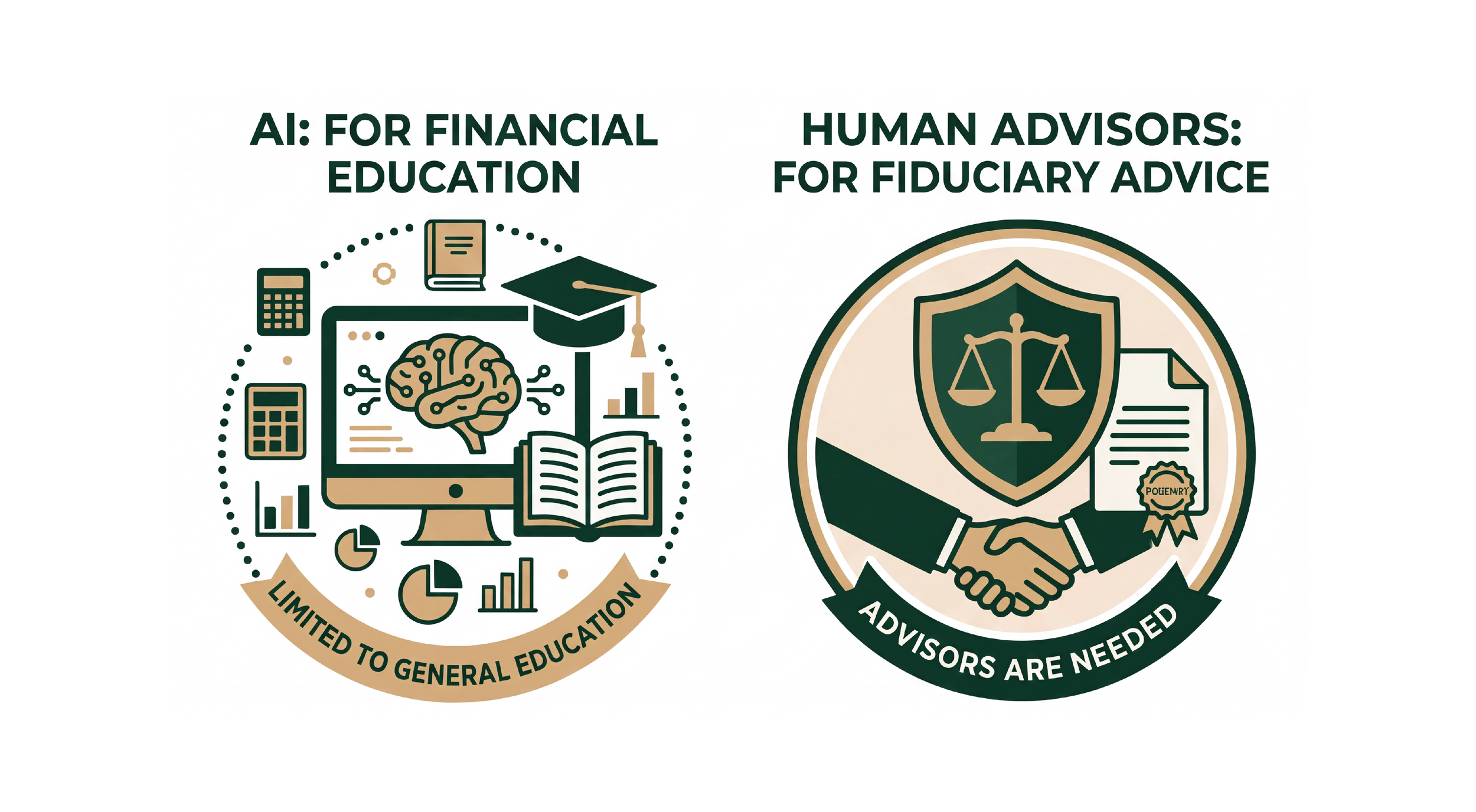
Artificial intelligence is fundamentally changing how individuals research financial concepts, build initial budgets, and explore hypothetical scenarios. However, treating an automated algorithm as a comprehensive financial plan can introduce unintended risks.
A balanced approach leverages technology for data processing and education, while relying on a professional advisor to navigate life's complexities and personal dynamics.
Strategic Ways to Leverage AI for Financial Literacy
Automated tools excel at structural organization, data analysis, and conceptual education. Consider using technology to build a foundational understanding:
Translating Financial Concepts: Use AI to clarify complex terminology—such as explaining the operational mechanics of tax-loss harvesting, the structural differences between account types, or standard regulatory rules—in plain language.
Hypothetical Scenario Modeling: Use tools to simulate math-based scenarios, such as comparing the mathematical timelines of debt payoff strategies or mapping out baseline savings targets under various inflation assumptions.
Organizing Personal Data: Use automated software to track cash flow, categorize historical expenses, and identify potential spending patterns over time.
Preparing for Consultations: Draft preliminary questions using AI to ensure you address key financial topics during your next strategy session with a professional.
Critical Limitations: Where Technology Falls Short
Algorithms process data based on historical patterns, but they lack personal context, regulatory accountability, and the ability to evaluate subjective human values. Avoid relying solely on technology for the following areas:
Absence of Fiduciary Accountability: Automated models operate without a regulatory fiduciary duty. They are not legally bound to act in your best interest, nor do they assume professional liability for the outcomes of their generated text.
Nuanced Tax and Estate Planning: Wealth management requires navigating overlapping federal, state, and local regulations. Software often overlooks state-specific legal nuances and the multi-layered tax implications of complex estates.
High-Stakes Life Transitions: Major life events—such as career shifts, corporate restructuring, business successions, or family changes—require subjective trade-offs. Static code cannot weigh personal risk tolerances or emotional realities.
Data Security and Privacy Risks: Entering sensitive information, proprietary business details, or specific account balances into public digital tools can expose private data to security vulnerabilities and third-party data harvesting.
The Distinct Value of Professional Financial Guidance
While technology streamlines information gathering, professional oversight focuses on integration, alignment, and ongoing execution:
Objective Behavioral Guidance: A key role of an advisor is providing objective perspective during periods of market volatility, helping to maintain structural discipline and focus on long-term strategy rather than short-term market noise.
Comprehensive Context Integration: Professional guidance incorporates the intangible variables of your life—family dynamics, personal values, career aspirations, and unique legacy goals—that cannot be captured in a generic search prompt.
Collaborative Professional Coordination: A human advisor acts as a central coordinator, collaborating directly with your CPA, estate attorney, and insurance professionals to align all components of your financial life.
Regulatory Compliance and Professional Standards: Registered investment professionals operate under strict regulatory oversight, providing transparency, formal documentation, and a structured framework for decision-making.
