

Navigating Tech Wealth & RSU Concentration
[Google Gemini AI generated image]
Is Comprehensive Investment Management Necessary?
A financial advisor specializing solely in investment management is not a universal necessity. Many individual investors can manage standard long-term assets effectively using low-cost index funds or automated platforms. However, when an individual’s or household's total annual compensation reaches the $500,000 threshold, they enter a distinct categorization known as 'High Earners, Not Rich Yet' (HENRYs).
While a $500,000 income in the San Francisco Bay Area may not equate to extreme asset wealth due to a historically high cost of living, it places a household firmly within the top 5% to 10% of regional earners. At this level, financial complexity shifts from simple investment choice to aggressive tax exposure, equity concentration risk, and structural cash-flow volatility.
The utility of a fiduciary professional changes under these conditions. The primary value shifts away from 'beating the market' and toward comprehensive tax mitigation, systematic diversification, and structural liability management.
The Core Structural Challenges of Equity Compensation
When a substantial portion of annual compensation—such as $200,000 out of a $500,000 total income—is delivered via Restricted Stock Units (RSUs), the household's financial stability becomes dependent on market mechanics.
The Supplemental Tax Under-Withholding Deficit
The Default Statutory Rule: By federal mandate, employers typically withhold a flat 22% for federal taxes on supplemental income, such as vesting RSUs.
The Marginal Reality: At an aggregate income of $500,000, a taxpayer’s federal marginal income tax bracket is 32% or 35% (contingent upon filing status).
The Projected Liability: This creates an automated 10% to 13% structural shortfall on the federal level alone, compounded by California's ordinary income tax rates, which apply fully to RSU vests without preferential capital gains treatment. Failing to make quarterly estimated tax payments or adjust W-4 withholdings systematically leads to sudden, large tax liabilities and potential underpayment penalties every April.
Behavioral Drivers of Equity Accumulation
The 'Found Money' Bias: Because RSUs vest automatically in the background, employees often perceive them as a separate bonus pool rather than 'real money' deducted directly from total compensation. This creates a psychological bias that leaving the asset untouched is inherently safer.
Misconceptions Regarding Capital Gains Taxation: A widespread misunderstanding persists that selling vested stock immediately triggers an additive tax liability. In reality, ordinary income tax is assessed on the full fair market value of the stock on the exact day it vests. Liquidating the shares immediately upon vesting establishes a cost basis equal to the sale price, resulting in near $0 in additional capital gains tax.
Structural Risks of 'Set It and Forget It' Accumulation
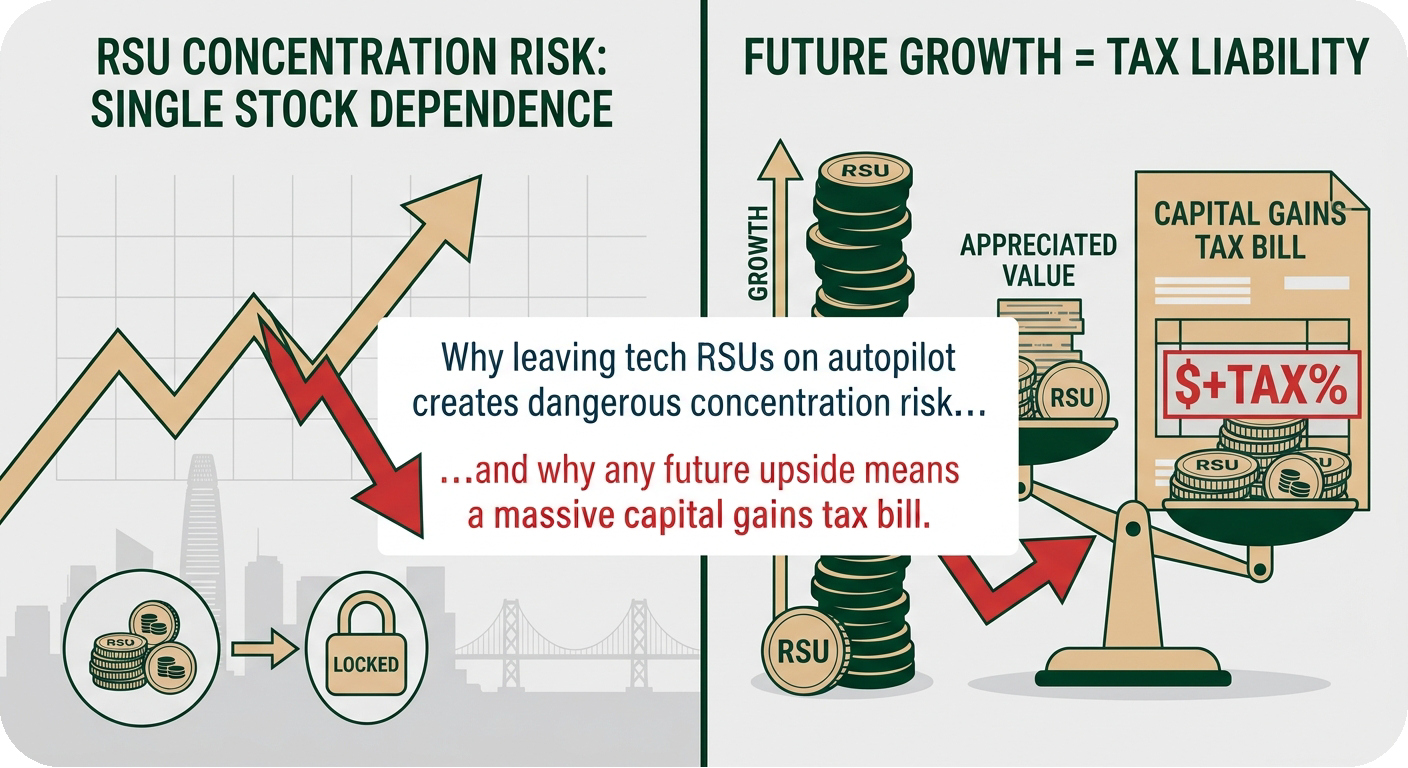
Extreme Concentration Risk: Tying 40% of active income and a matching portion of personal investments to a single corporate entity means a household's livelihood depends entirely on one boardroom. If the company encounters an operational downturn, regulatory actions, or adverse earnings reports, both career stability and personal net worth contract simultaneously.
The 'Golden Handcuffs' Tax Trap: If an unmonitored stock appreciates over multiple years, any subsequent decision to liquidate those shares—whether to purchase a primary residence or execute a career transition—will trigger a significant deferred capital gains tax liability on the growth. The investor effectively becomes trapped in a single equity position due to the high fiscal cost of exit.
Historical Case Studies in Equity Volatility
The high volatility inherent in concentrated tech equity positions is illustrated by market events from the near past. The 2022 tech bear market serves as a stark baseline for how rapidly unliquidated equity compensation can lose value.
Meta Platforms, Inc. (2022)
Market Context: Driven by macro inflationary pressures and substantial capital reallocation toward unproven technologies, Meta experienced a prolonged contraction.
Peak-to-Trough Drawdown: The stock declined approximately 75% from its previous record highs, culminating in a historic single-day market cap reduction of 26% on February 3, 2022.
Wealth Impact: An employee who maintained a concentrated holding of $400,000 in vested, unliquidated Meta RSUs at the market peak saw the nominal value of those realized earnings fall to approximately $100,000 within twelve months, despite having already paid ordinary income tax on the higher initial vesting value.
Netflix, Inc. (2022)
Market Context: A deceleration in global subscriber growth numbers disrupted historical growth valuations.
Peak-to-Trough Drawdown: Netflix equity suffered a one-day decline of over 35% on April 20, 2022, and ultimately experienced a maximum peak-to-trough drop exceeding 70%.
Wealth Impact: Tech professionals treating their equity accounts as passive savings experienced substantial capital erosion. Because income tax is calculated and locked based on the fair market value at vest date, these individuals absorbed permanent capital destruction on assets that had already been taxed at peak ordinary rates.
Strategic Wealth Preservation Frameworks
To mitigate these structural exposures, fiduciary advisors design rule-based financial frameworks that separate lifestyle funding from market-linked equity.
The Base-Salary Lifestyle Mandate
A foundational risk-mitigation rule is to match all fixed, non-discretionary liabilities—such as jumbo mortgages, property taxes, insurance, and baseline living expenses—strictly to the guaranteed, liquid W-2 base salary.
When a family relies on an unliquidated RSU price to hit a specific threshold simply to service regular monthly debt, any market drop forces the household to take on high-interest debt or liquidate shares at a market bottom.
The Systematic Sell-on-Vest Architecture
An optimal framework treats RSUs identically to a cash bonus. Because the ordinary income tax liability is established instantly on the date of vest, selling immediately on vest incurs near to zero additional capital gains tax.
Advisors coordinate automated liquidations through company equity portals to immediately transfer proceeds into globally diversified index funds, eliminating emotional timing biases and capping single-stock concentration.
Professional Mediation of 'Forgotten' Equity
A fiduciary advisor establishes systematic protocols to manage legacy stock piles and remove emotional decision-making:
Automated Liquidation Schedules: Advisors synchronize with equity administration platforms to enforce automated 'sell-on-vest' rules, directing cash immediately into broader asset allocations.
Neutralizing Emotional Trading Bias: Human behavior often encourages holding shares in anticipation of marginal price recoveries. Advisors mitigate this by applying objective standard asset allocation rules, treating the equity as cash value to be optimally positioned.
Tranche-Specific Tax Cost-Basis Auditing: For legacy accounts with multi-year accumulations, advisors conduct detailed cost-basis audits to systematically unwind the concentrated position over time, optimizing the disposal schedule to minimize capital gains exposure.
Operational Value Analysis: Self-Directed vs. Fiduciary Managed
The operational value of engaging a fiduciary advisor varies across core wealth management categories. This comparison highlights the structural distinctions between self-directed execution and professional oversight for a tech professional navigating high equity compensation.
How an Advisor Fixes "The Forgotten Stock" Problem
This is exactly where an advisor delivers immense structural value that pays for itself. Instead of letting you rely on memory or emotion, an advisor implements a strict, automated system:
Implements a "Sell-on-Vest" Schedule: An advisor will sync with your Equity Platform (like Morgan Stanley Shareworks, Schwab, or Fidelity) to create a rule: the moment RSUs vest, they are automatically liquidated and the cash is swept into a globally diversified portfolio (like an S&P 500 or total market index).
Removes the Emotional Bias: It is human nature to look at a stock and say, "I'll wait until it goes up another 5% to sell." Advisors remove this gambling mindset by treating RSUs exactly like a cash bonus. (If your company gave you a $20,000 cash bonus today, would you immediately use 100% of it to buy shares of your own company? If the answer is no, you shouldn't be holding the RSUs).
Tracks the Tax Cost Basis: If you already have years of "forgotten" stock piled up, an advisor will audit your tranches to see which shares can be sold with minimal tax impact, systematically unwinding your risk.
